Critic of Comfort Women memorial praises Confederate memorial in Georgia

In March 2018, far-right activist Yumiko Yamamoto of Nadeshiko Action traveled to Brookhaven, Georgia to stage a protest against the “comfort women” memorial installed in the City’s Blackburn Park, joined by another Nadeshiko Action member Shizuko Culpepper from Minnesota. They apparently took particular offense to the fact that the City celebrated annual cherry blossom festival in the same park that week, as the two felt that cherry blossoms was “the symbol of Japan” and should not be juxtaposed along the comfort women memorial.

During the same trip, Yamamoto visited the infamous Confederate memorial in Stone Mountain, Georgia and gave a speech to a conservative group after she returned to Japan, on April 19th (YouTube). The speech is in Japanese, but she repeats much of the same thing in an English advertisement published on the June 2, 2018 edition of Weekly NY Seikatsu, a mostly Japanese language publication for Japanese residents in the New York area (PDF version here).
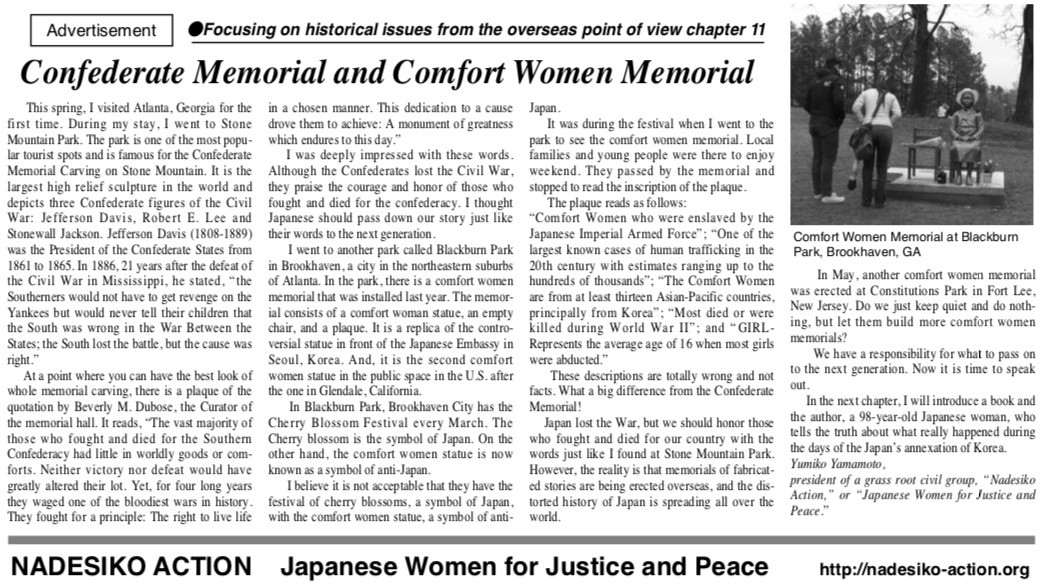
In the opinion ad, Yamamoto praises the Stone Mountain Confederate Carving, one of the largest stone reliefs in the world depicting Confederate President Jefferson Davis, Generals Robert E. Lee, and Thomas J. “Stonewall” Jackson. Quoting Davis, Yamamoto writes: “In 1886, 21 years after the defeat of the Civil War in Mississippi [Jefferson Davis] stated, ‘the Southerners would not have to get revenge on the Yankees but would never tell their children that the South was wrong in the War Between the States: the South lost the battle, but the cause was right.'” In her Japanese speech, she adds: “likewise, Japan lost the battle, but our cause was right,” showing her adoration of the white supremacist Confederate “Lost Cause” myth.

Yamamoto further writes, “Although the Confederates lost the Civil War, they praise the courage and honor of those who fought and died for the confederacy. I thought Japanese should pass down our history just like their words to the next generation.” She contrasts the memorial praising Confederate soldiers with memorials dedicated to the victims and survivors of Japanese military comfort women system, arguing that comfort women memorials are “totally wrong and not facts.” “What a big difference from the Confederate Memorial!” exclaims Yamamoto.

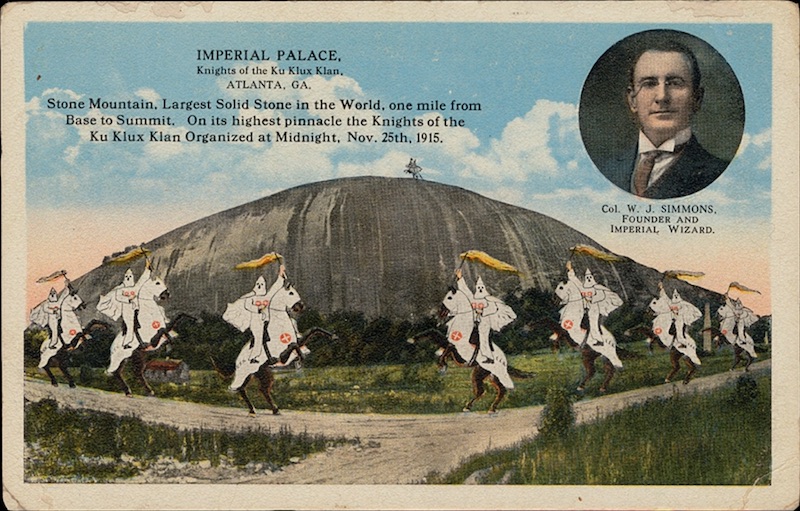
Stone Mountain is the exact site of the 20th century revival of the Ku Klux Klan, who climbed up to the summit of the mountain on Thanksgiving Day, 1915 to give birth to a new generation of the Klan after the original Klan from the 19th century went dormant. The KKK held enormous annual cross burnings at the site for decades since then.

The Confederate carving was proposed by C. Helen Plane, a charter member of the United Daughters of Confederacy. The construction was delayed repeatedly until the segregationist Governor Marvin Griffin pushed the state to purchase Stone Mountain and complete the project. Even today, Stone Mountain continues to serve as a sacred spot for white supremacists, for example as the campaign launch location for former KKK leader and frequent political candidate David Duke, even as the criticisms toward memorials glorifying the Confederacy spread across the American South. It is for this symbolism Dr. Martin Luther King, Jr. declared “Let freedom ring from Stone Mountain of Georgia” in his famous “I have a dream” speech in 1963.

Yamamoto’s adoration for Confederate leaders and memorials is perhaps not an accident: until late 2011 she was the vice president and secretary-general of Zaitokukai, an extremist anti-Korean hate group that target Korean children, families, and businesses. She has never renounced or denounced Zaitokukai even after exiting the organization, explaining in her 2014 book that she only left the organization to focus on the comfort women issue. In fact, Nadeshiko Action continues to spread anti-Korean extremist rhetoric, for example by submitting a letter to the United Nations Commission on the Elimination of Discrimination Against Women (CEDAW) titled “Hate speech masquerading as Anti-Hate speech by privileged Korean Residents in Japan,” alleging that Koreans living in Japan enjoy special privileges over Japanese nationals, which is the core (and unfounded) talking point of Zaitokukai.

The 2018 short documentary Graven Image by Sierra Pettengill uses archival footages to tell the history of the Stone Mountain and its place in the continuation of white supremacy in America. Graven Image can be viewed online thanks to PBS’ POV series.
Alert: Right-wing groups use Japanese-language publications to “educate” Japanese residents in the U.S.

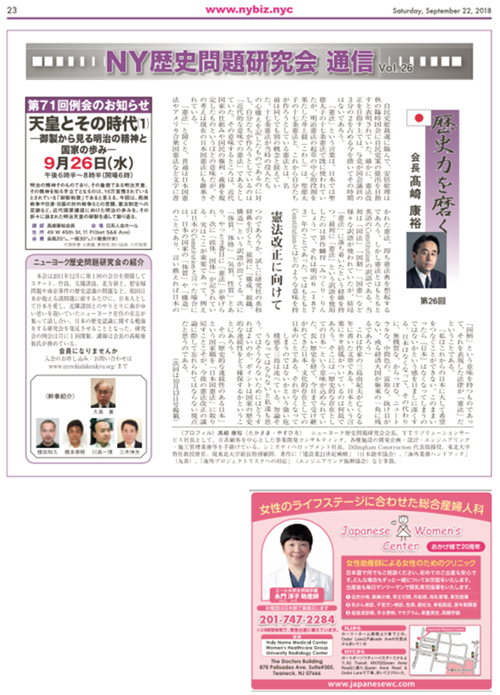
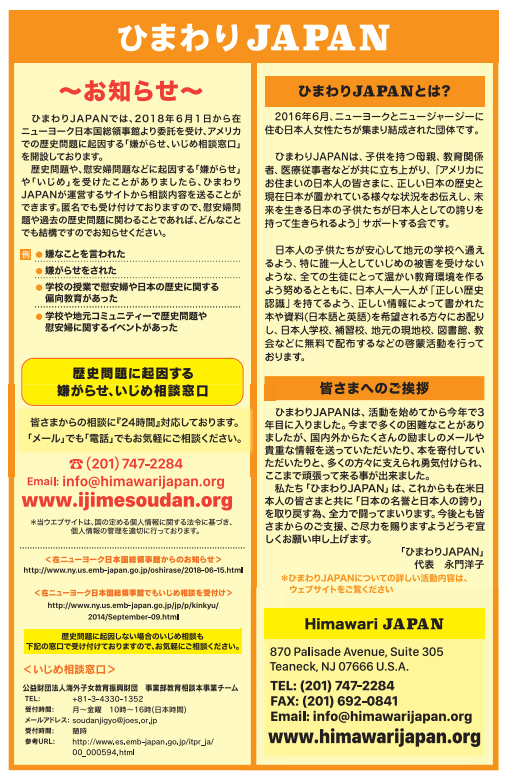
As Japanese right-wing groups accelerate their efforts to mobilize Japanese communities in the U.S. against what they perceive as “anti-Japan” historical awareness campaigns (especially on the topic of Japanese military “comfort women” system), Japanese-language free newspapers became a vehicle for their “educational” outreach. We have obtained recent copies of two such publications from New York, New York Biz and Weekly NY Seikatsu, both of which publish large opinion advertisements from far-right Japanese historical revisionist organizations including Nadeshiko Action, Global Alliance for Historical Truth, Himawari Japan, and New York Historical Issues Study Group as well as news articles detailing their activities.

New York Biz, published by Weekly Business News Corp. began featuring a regular column by New York Historical Issues Study Group in September 2016. The first installment was a report about the Study Group’s most recent meeting in which Tsutomu Nishioka, Shiro Takahashi, and Tetsuhide Yamaoka gave lectures. Himawari Japan began publishing ads a year later, in September 2017.

Himawari Japan and other groups including Nadeshiko Action frequently publish ads on New York Biz. For example, the latest (September 22, 2018) issue contains a full-page ad from Himawari Japan seeking readers to submit information about anti-Japanese bullying motivated by “historical issues” as well as “anti-Japanese” education at schools and any community activities about the “comfort women” issue or other topics on Japan’s history. The same issue also publishes the number 26 of New York Historical Issues Study Group’s regular column and a midwifery ad by Yoko Nagato, the leader of Himawari Japan.

Similarly, Weekly NY Seikatsu began publishing a series of opinion ads by Japanese right-wing groups every week since January 2017, starting with a column by Koichi Mera of the Global Alliance for Historical Truth published alongside a news story about the decision by the City of Fort Lee, New Jersey to enact a comfort women memorial (which cites oppositions from comfort women deniers including Himawari Japan’s Nagato and Kent Gilbert) and an opinion piece by Masaki Shirota, a dietary supplements company president who is identified as a “music producer” (whose musical experiences appear to consist of his glee days in college), on how the “comfort women issue is a blatant lie.”

While New York Biz is an all-Japanese publication, Weekly NY Seikatsu devotes one page from each issue to English-language news and opinions, many of which are English translations of articles from Yomiuri Shimbun, Japan’s leading conservative daily. Global Alliance for Historical Truth, Nadeshiko Action, and other right-wing Japanese organizations publish ads on each issue of Weekly NY Seikatsu, alternating between Japanese-language ads and their English translations. Contents of these ads mostly consists of recycled right-wing talking points that have been thoroughly debunked years ago, but there are some new commentaries including Nadeshiko Action president Yumiko Yamamoto’s glorification of Confederacy leaders and monuments in Stone Mountain, Georgia. Weekly NY Seikatsu even has a section on its website dedicated to archiving these right-wing opinion ads.

These advertisements threaten to blur the line between (highly dishonest) paid advertisements and news. For example, an opinion piece by the aforementioned self-identified “musical producer” Masaki Shirota was published as a Japanese commentary on the May 12, 2018 issue of Weekly NY Seikatsu, but when it was re-published in English in the June 16, 2018 issue it was labeled as “opinion advertisement.” The paper also regularly includes comments from members of Nadeshiko Action and Himawari Japan when reporting about anything related to the comfort women issue, even though the newspaper does not appear to be politically slanted to the hard right on any other subject.

As newspapers continue to lose revenue due to the shift of advertising dollars to the internet, regular advertisements may give well-funded far-right groups disproportionate influence on the content of Japanese-language publications that many Japanese people in New York and in the rest of the U.S. rely on. Propaganda ads that falsely portray Japan as the victim of massive anti-Japanese historical campaigns by Chinese and Korean communities may even lead Japanese people living in ethnic enclaves to feel fearful of their Asian and Asian American neighbors and further isolate themselves from the American mainstream. We need to increase outreach to Japanese-speaking communities to break their isolation and share our experiences of allyship with larger Asian American communities to help them integrate more fully with the surrounding communities.