
Thank you, Central Washington University community!

Here’s the “comfort women” denier bingo! If for some reason you were to attend a Japanese far-right revisionist lecture (like the one at Central Washington University next week) or watch a revisionist video, use this bingo to track how frequently these thoroughly debunked right-wing denier arguments are made. Click on the image to download the PDF version for printing at home. Enjoy!
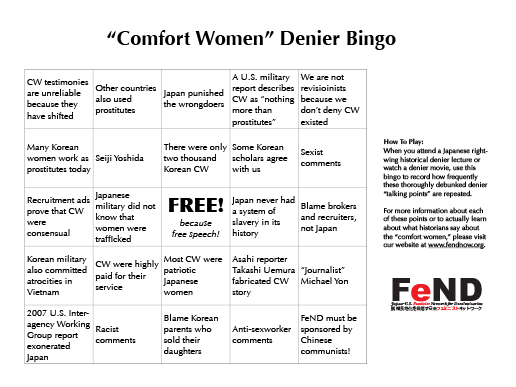
For more information, read Debunking the Japanese “Comfort Women” Denier Talking Points.
Aside from the 1944 U.S. military report that we analyzed previously, there are a few more historical documents that the Japanese far-right historical revisionists use repeatedly as “evidences” that “comfort women” were not systematically trafficked by the Japanese military and its contractors, but were recruited legally and ethically. These documents come in three categories: 1) recruitment ads published in Korean newspapers seeking applicants for “comfort women”; 2) the 1938 directive by Japan’s Deputy Army Secretary requesting the military to carefully vet contractors recruiting and managing “comfort women” to ensure that their conduct would not “disgrace” the Japanese military; and 3) newspaper articles that “prove” that Japanese government prosecuted kidnapping and forced prostitution.
Let’s start with the recruitment ads. Right-wing nationalists argue that the existence of ads explicitly recruiting “comfort women” proves that the recruitment was done fair and square, and that their pay was quite high. But there is a problem with it: the literacy rate for Korean women of that generation was low. In other words, except for a small number of elites, who would probably not voluntarily choose to become “comfort women,” Korean women at the time would not have been able to read the ads.
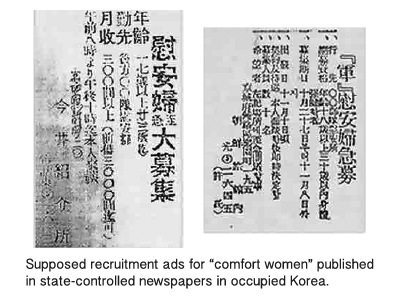
Historians believe that these ads were not actually targeted toward potential “comfort women” applicants, but toward independent recruiters and subcontractors that would supply the contractor with the women that they could then ship to “comfort stations” across Asia. Thus, the only thing these ads prove is the existence of a market to buy and sell women, and they do not indicate how these women were recruited. Besides, only two such ads have been discovered so far, and cannot be responsible for the recruitment of all the women who became “comfort women.”
Which brings us to the next document: the 1938 directive by the Deputy Army Secretary that denounces recruiters that use deceptive or otherwise problematic tactics that “diminish the military’s dignity” and urges Japanese military to carefully vet contractors. This document was first publicized by Asahi Shimbun newspaper in 1992 as a proof that the Japanese military was directly involved in the operation of the “comfort women” system, but since then reclaimed by the right-wing nationalists as an evidence for what they call “good involvement”–that is, the argument that Japanese military’s only involvement with the “comfort women” system was to prevent trafficking and protect women.
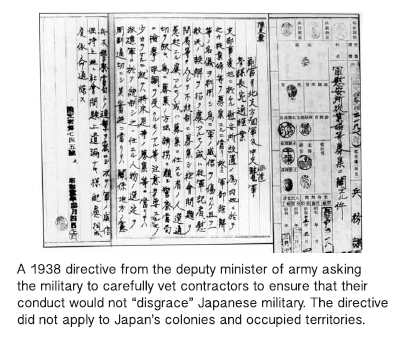
The impetus for this directive came from early stages of the “comfort women” deployment, when most “comfort women” were still Japanese women. The military tried to recruit “comfort women” from women who were already working at brothels (most likely under debt bondage), luring them with a way to repay their debt more quickly. But some contractors began luring other, “pure” Japanese women by deceiving them about the nature of the “good job” they were offering, and it led to criticisms from within Japan. The 1938 directive specifically mentions instances of kidnapping and deceptive recruitment in Japan, and it only applies to recruitment in Japan. No comparable directives have been issued that applied to Japan’s colonies (Korea and Taiwan) or its occupied territories.
To counter this criticism, the right-wing nationalists often produce newspaper articles about arrests and prosecution of individuals who kidnapped or sold women into prostitution in Korea. But these are cases of simple kidnapping or forced prostitution by criminal elements, and do not show that Japanese government properly regulated its licensed contractors who recruited Korean women for Japanese enforced military prostitution, or that it protected Korean women from such recruitment.
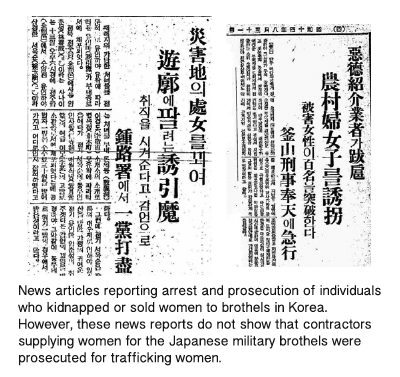
Japan was a signatory to the International Convention for the Suppression of the Traffic in Women and Children of 1921, which prohibited the recruitment of women under the age 21 for prostitution even with her consent, as well as the use of force, fraud, or coercion (including debt bondage) in the recruitment of adult women for prostitution. However, when Japan signed the treaty, it declared that new treaty would not apply to its colonies (Korea and Taiwan) or occupied territories, clearly indicating the Japanese government’s conscious policy choice to permit and sanction the trafficking of Korean and Taiwanese women and girls, which helped to further its imperial war of aggression in Asia and the Pacific.
Members of Central Washington University community are outraged about the upcoming film screening and lecture later this month on campus by a professional Japanese “comfort women” denier and a failed 2011 candidate for the governorship of Tokyo receiving 0.2% of the votes, Mr. Yujiro Taniyama. At the invitation of Japanese language instructor Ms. Mariko Okada-Collins, Mr. Taniyama will show his fauxcumentary “Scottsboro Girls” on April 28th and 29th at CWU, located in Ellensburg, Washington.
While Taniyama claims to introduce a new perspective that “challenges the conventional wisdom” regarding the “comfort women,” his film seems, based on the trailer posted on YouTube, to recycle the same old revisionist talking points that have been thoroughly debunked, including the oft-misrepresented 1944 U.S. military report.
In response to the upcoming events, anthropologist Dr. Mark Auslander and others have organized an academic panel to discuss the true history of “comfort women,” featuring specialists from CWU community as well as from other universities. In addition, performance arts students are putting on a public reading of the testimonies of former “comfort women” on campus to raise awareness of the issue. (Download the PDF flier of the event here.)
Mr. Taniyama and Ms. Okada-Collins insist that they are simply trying to uncover truth or to present an alternative perspective on the topic, but their reliance on misrepresentations of historical documents and contemporary scholarly works (mainly those of Korean scholars Ahn Byong Jik and Park Yuha, neither of whom actually agree with Mr. Taniyama’s or Ms. Okada-Collins’ views) prove the fundamental dishonesty of their historical revisionist project.
In recent years, Japanese far-right nationalists have declared the U.S. to be the “shusenjo,” or the main battleground, in their “history war” on “comfort women.” Their goal is to recruit as many politicians, journalists, opinion leaders, and scholars as possible to question the orthodox narrative of “comfort women” as the victims of a system of enforced military prostitution. The CWU events are a significant development in their campaign because it is the first time that a U.S. college or university allowed itself to play host to the Japanese equivalent of neo-Nazis on its campus.
The problem with giving an academic platform to historical deniers, whether they are denying crimes of the Holocaust or those of “comfort women,” is that they do not have to prove their points or convince us of their propaganda in order for them to win. They can claim victory simply by introducing enough doubt in the legitimate history; they can win simply by projecting an impression that legitimate historians might be on both sides of controversy regarding the historical crime they are denying, or by making others accept their premise that they are seeking the truth. Anything short of recognizing them as fundamentally dishonest and unscholarly political campaign is a victory for them.
There can certainly be legitimate disagreements about the exact number of “comfort women” (i.e. whether there were tens or hundreds of thousands) or the extent to which Japanese military was directly involved in the trafficking and exploitation of women in the system, but there is no disagreement among the academic community that Japanese military established, maintained, and managed a system of enforced military prostitution that relied on force, fraud, or coercion against women of its colonies and occupied territories.
We are also concerned that in a letter published on Mr. Taniyama’s website, Ms. Okada-Collins admits to teaching her version of “truth” of modern East Asian history in her classes, which includes denial of Nanjing massacre (the “Rape of Nanjing”) and “comfort women.” In the letter, she explains her belief that teaching of language must include “instructions” on culture and history, and states that she uses every opportunity in her classroom to discuss “China-centrism, colonial policy, and recent history between Japan and China/Korea.”
“Some of my students are not Americans, but Koreans, Chinese, or Taiwanese who may reject my views at first, but most of them eventually agree with me,” Ms. Okada-Collins writes. She further explains that some students have complained in the student evaluations that she is unfit as an instructor and should be fired by the university for denying historical atrocities such as the Nanjing massacre and the sexual enslavement of Korean “comfort women.”
We may or may not agree about whether or not the academic freedom protects the rights of historical revisionists to air their views on campus, but we don’t think that there is any doubt that language instructors should not be forcing her repulsive racist, sexist, revisionist views on their students, especially those who are Korean, Chinese, or Taiwanese. In fact, it may constitute a violation of students’ civil right to be free from racist and sexist practices in classrooms.
We are further alarmed that Ms. Okada-Collins have persisted in this practice despite the fact that students have formally complained about her abuse of the position. Is it a stretch to suggest that the university’s earlier failure to act on that knowledge resulted in the full-fledged historical denier event being planned on campus? We are not suggesting that Ms. Okada-Collins should be immediately fired, but we believe that she needs to be instructed to change her behavior in her classroom. Students deserve better, especially Asian and Asian American students who are directly harmed by her unprofessional behavior.
(P.S. – Can we also comment how offensive that Taniyama’s denier film’s title appropriates the case of Scottsboro Boys, the nine young Black men who were unjustly charged with raping white women in 1931 by the racist police/prosecutors and an all-white jury?)
“Breaking the History of Silence” is a documentary film from the historic 2000 Women’s International War Crimes Tribunal on Japan’s Military Sexual Slavery that was convened by non-governmental organizations and international team of legal experts to hear the testimonies of victims of Japan’s “comfort women” system during the WWII and to try those responsible for the crime.
The full documentary (68 minutes) in English is now available for viewing online.
You can also watch the digest version of the film, as well as each testimony by itself on Fight for Justice.